


1. Who We Are and How It All Began
My name is Bänz Margot – founder and president of the association «humanfrontaid.org». Ukraine is the largest country in Europe. Actually a very rich, beautiful country. I have vacationed there several times. Including last year.
Actually, I'm a Bernese musician and not the director of an aid organization. But on February 24, 2022, I woke up in Odesa in my hotel – and suddenly there was war. One can hardly imagine a more dramatic end to a vacation. Days before, the tension in the port metropolis was palpable. Now it gave way to total uncertainty: Nobody knew whether Odesa was an immediate target of the Russian Black Sea Fleet; whether Russian troops would invade the city by land or from the air. The dimension of the events quickly became clear to me. Odesa airport had already been bombed at that time.
In this situation, I decided to do what thousands of people in Ukraine were doing: I fled overland to Chisinau, the capital of Moldova. When I arrived there, I instinctively knew immediately that I couldn't simply continue my journey to Bern: Too desperate were the faces of the children, mothers, grandmothers and grandfathers who were looking for help everywhere in the city. Men of military age were not allowed to leave Ukraine. It was clear that a tragedy with vulnerable refugees was unfolding here, the likes of which Europe had not seen since World War II.
I decided to stay and help. Together with some friends from Switzerland, we founded «humanfrontaid.org» in Chisinau. However, there was truly no time to write statutes at this point: We distributed tasks, organized ourselves as best we could at the time, and activated our networks.
2. The Phase of Evacuations and Aid Deliveries
On all my social media channels, I raised awareness in my personal circle and received first donations. We organized transport capacities, brought food from Chisinau to Ukraine and took refugees with us on the return journey to Moldova. The first weeks and months were characterized by chaos. Our will was always to help quickly and uncomplicated – which we did from the first day of the war. I'm not an accountant and statistics don't have top priority in the chaotic phase of war.
Based on all records, we can trace the quantities fairly precisely: We enabled 5,750 people to flee – also through corridors from occupied areas. We brought 15,000 cans of food into the war zone and to the front lines; 67,000 portions of baby food; 62,000 diapers; as well as hygiene articles and medicines that were urgently needed.
From the end of April, it became clear that Ukraine would not fall within a few weeks, but could withstand the war of aggression. On the contrary, Russian troops were increasingly pushed back in the north of the country and Ukraine was able to achieve significant territorial gains. Although Russian missile attacks – not on military targets – but on residential buildings and infrastructure facilities posed a permanent danger, I decided to return to Odesa in May. There I began to network with various local volunteer organizations and to continue the work started on site – in Odesa itself. The evacuations now focused on the contested regions along the front line such as Kherson, Mykolaiv or Energodar. Along the contested areas, the destruction is almost total. The city of Mariupol – once a flourishing coastal metropolis – no longer exists. People who fled to Odesa from the formerly occupied areas report unspeakable suffering, torture, arbitrariness, executions. Many are severely traumatized. The Ukraine war has severely affected the lives of many people in Odesa and other places in Ukraine. Injured and poverty-stricken people urgently need help to rebuild their lives. Thousands of internally displaced people are stranded in Odesa, who have little more than what they can just carry with them.
In autumn, the harbingers of winter slowly announced themselves. The power supply in the city was partially interrupted and the million-strong metropolis was partially completely in the dark during the lengthening nights. We began collecting blankets, sleeping bags, candles, stoves and everything that warms through social networks in Switzerland. However, we quickly found that the logistics of bringing these things to Odesa were enormously complex. The large aid organizations struggle with this phenomenon at least as intensely: A container with winter jackets reached Odesa in March '23 – when it was already spring-like.
3. Christmas in Bern – It Wasn't a Time-Out
It's hard to admit to yourself: But all the desperate people, the destroyed houses, the disturbing stories, the explosions of incoming rockets – they make you tired and gnaw at your psyche. So I decided to take a time-out with my family in Bern for Christmas.
At first it was difficult for me to properly classify «normality» again. And the «worries» of some Bernese seemed almost surreal to me. However, there was ultimately no time for reflection: We professionalized the accounting, wrote effective statutes with a law firm that offered us this as a donation, and continued working on our network: The Ukrainian community in the city of Bern is now considerable and well organized, the Burgergemeinde has close connections to Lviv, and politics began to take an interest in our work: So we founded a «patronage committee»: Bern city councilor Reto Nause was able to inspire National Councilor Matthias Aebischer, National Councilor Kathrin Bertschy, former government councilor Béatrice Simon, National Councilor Gerhard Pfister, the CEO of YB, Wanja Greuel and the former zoo director, Bernd Schildger for our cause! In the Bern city parliament, numerous members donated their session fees in favor of «humanfrontaid.org».
I participated in numerous solidarity rallies in favor of Ukraine. I did there what I had actually never done before: I gave speeches. Later – on March 4, '23 – we were even allowed to make a live connection from Odesa to the national solidarity rally on the Bundesplatz. The volunteers felt the solidarity of 10,000 people.
Another new experience in my life was added: The media. Local television, radio stations and print media began to take an interest in our work. There are people who «bask» in media interest – for me it was rather stress. But the bright side of it was donations for «humanfrontaid.org» after each appearance.
4. The Return and the Concept of Direct Financial Aid
The new year began and I felt the urge to return to Odesa. In a discussion with Hugo Fasel – a close friend of the family – the realization matured that we had to reorient our aid: We now support families with direct cash assistance, which has four advantages:
• On the one hand, people can buy exactly what they need most urgently: For example, rare medicines, infant food, clothes.
• On the other hand, the money flows directly into the local economy, which is thereby strengthened. The local economic structures are impaired – but quite intact!
• The complex logistics are eliminated: If I can directly finance an asthma spray for a child's mother, she will have it in the shortest possible time. If we had to organize such sprays, it would take significantly longer.
• The fact that we focus on financial cash assistance also has another reason: We have found that material aid in the form of food or other essential products often does not reach those who need it most urgently. Corruption is unfortunately still an issue in Ukraine today.
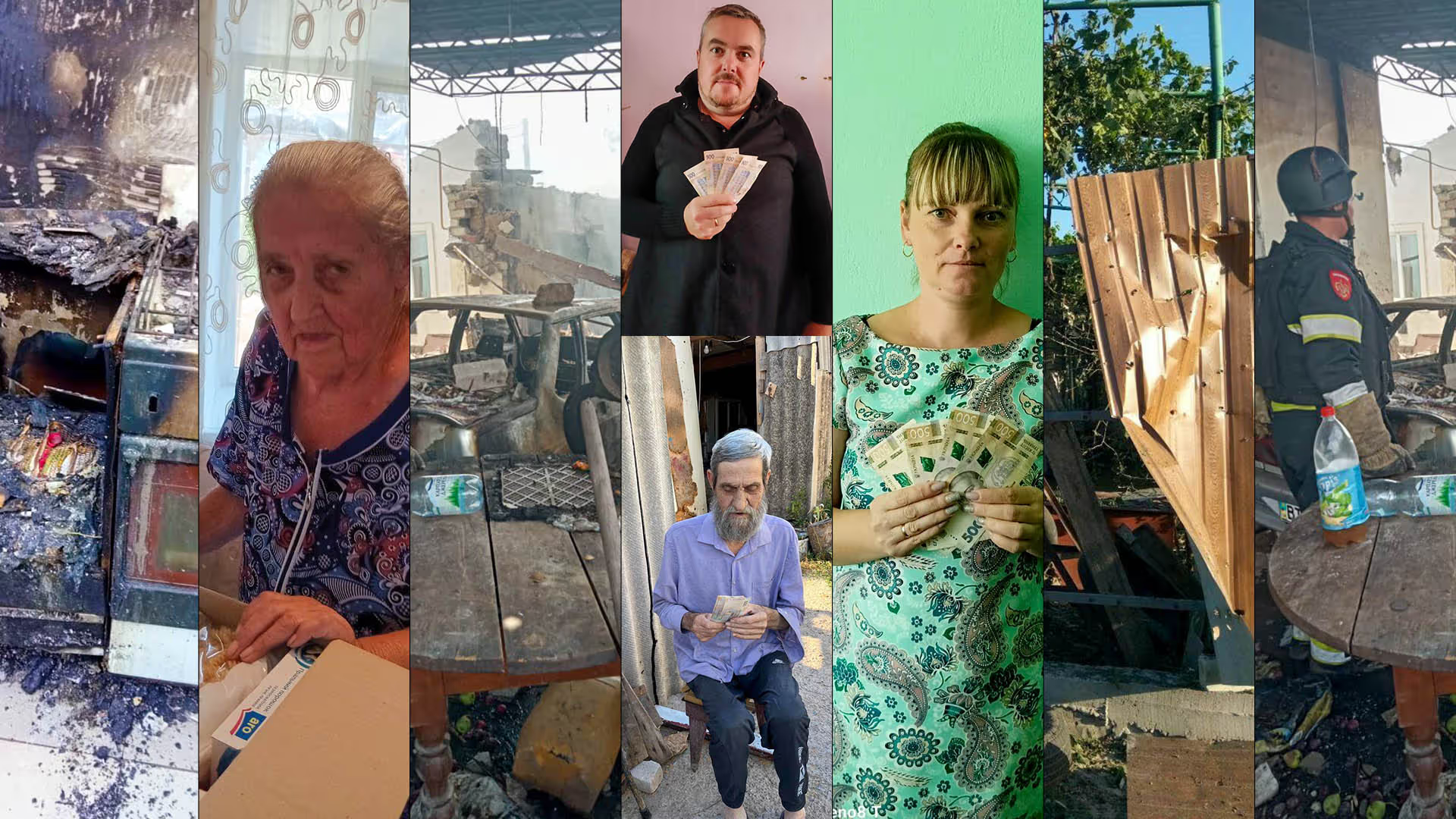
We focus on those who have been hit hardest: Single mothers, families who have completely lost their homes, people with illnesses and elderly people. In the last three months alone, we have already supported 1,000 families in this way. Let me describe three such fates for explanation:
A young woman fled with her children and her mother from Bakhmut to Odesa. A Russian projectile had hit her mother's neighboring apartment. Her apartment was completely damaged. Since the detonation, the mother has suffered from a severe mental disability. If life with a disability is already difficult in Switzerland, how much more difficult is it then in a war zone!
Another family – homeless after Russian shelling – used the money to buy bus tickets so they could stay with relatives in northwestern Ukraine.
A child of another family suffered from a rare disease. His survival depended on an operation. However, this was only possible in Kyiv. We financed their journey to the hospital.
I could tell hundreds of such fates. And unfortunately there will be more! I thank everyone who has supported us so far and will continue to support us! Here in Odesa – 144 kilometers from the nearest front line – the invested franc efficiently and unbureaucratically alleviates human suffering!
Odesa, April 20, 2023
Bänz Margot
Contact & Donation Account
IBAN
CH90 0023 5235 3080 4540 J
Human Front Aid
Schifflaube 34
3011 Bern
Schweiz
info@humanfrontaid.org
